
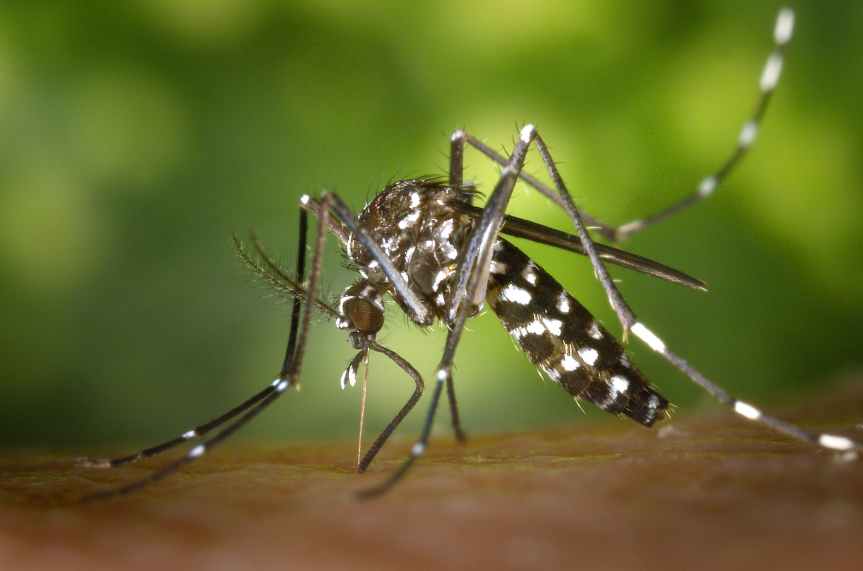
I have a terrible time with mosquitoes.
I attract them every time I’m outside. And my reaction to the bites—what one of my physicians diagnosed as a “moderate allergy”—is atrocious. Even if I never touch it, the bite swells to two and three times the size, itches madly, aches. I sometimes develop a low-grade, random fever in response.
Good times!
But I have learned over the years how to approach the problem. I load up on deep woods bug spray before I go out. I flee indoors at hotspot times. I avoid standing water. And when I do get bitten, I immediately take a 24-hour allergy pill and that helps matters immensely.
Still, life happens.
One year during a fireworks display I incurred a record 22 bites in one and a half hours. And just recently I walked outside, incurred seven bites in the span of an hour, went for another walk later that day, and incurred four more—all on my foot.
I took my pill. I went about my business. Seemed fine.
And then the next day I woke up with my entire foot on fire from itching. Only four bites, but they itched more than all of my other previous bites put together. My foot swelled and turned red. The bites bled together into one massive monster-bite that was so gross I refused to let my husband look at my foot.
I was miserable.
Who knew, I thought, that four little bites could cause this much agony?
But that’s the way it goes, I think. It’s the little things. The mild annoyances. The small frustrations and daily hurts. They mound up and pile together until they’ve all bled into something overwhelming and monstrous, too big for us to stand up against.
I encountered this real-time recently when I had a conversation with an acquaintance who interrupts me regularly. Eight times out of ten, regardless of what I am saying or how, he interjects mid-sentence—often on a completely different topic—and takes off without any regard for my bewildered pause.
I know this person has a high regard for me, and he’s always treated me well and advocated for me. He’s a decent person. I think it’s just a bad habit, or a lack of self-awareness. And while it’s something I might gently mention to people I’m close to and ask them to amend, it’s not a mountain I’m willing to climb with an acquaintance I see only infrequently. My general response is to give a bewildered look, shrug it off, let him talk.
But the other day he interrupted me, and after our conversation I walked to a private place and cried.
It felt so disrespectful, I explained to my husband later—again in tears. It’s as though I exist only as a receptacle for whatever he wants to say and anything I try to convey is deemed useless or worthless.
But it was also about much more than the interruption. It was about a thousand tiny hurts: friends who don’t check in despite all my best efforts to check in on them, work indignities, missing my mom, small frustrations and disappointments. It all blurs together.
And this is helpful for me to remember, when it comes to loving others.
It helps me to be generous in my grace-giving. Yes, a person might seem “unnecessarily” cranky or overwrought or frustrated when I encounter them—but I also don’t know what else they’ve already had to deal with that day, that week, that month, that life. Yes, maybe I only forget to call them back by accident, but that doesn’t make the fifteenth hurt of a difficult day a smaller hurt. Why not, in my engagement with people, be more considerate rather than less?
It’s easy to give grace to people dealing with the Big Things: illness, sickness, death, tragedy. We know how to do that. We speak in soothing voices. We excuse quirks in behavior. We make allowances. We sympathize.
But, you know, life hurts generally, sometimes, and in small ways as well as large.
A particular friend of mine is a breast cancer survivor. She was diagnosed immediately after a devastating breakup with her then-fiance. Her world was thrown into upheaval, and she underwent a grueling regimen of chemotherapy and radiation while mothering her precocious little toddler.
She recovered. The chemotherapy and radiation did its job. Her hair has mostly grown back and she is back at work, back in her life. When I met her recently for a talk over cake, she sat down with a piece of red velvet. After we exchanged pleasantries, I asked, “But how are you? Really?”
“Well, you know.” She paused. “The cancer is gone, and I’m so grateful to God. But I am still on a maintenance medication I have to finish, and…” She shook her head and teared up. “I’m so tired some days. It’s still so hard. But there aren’t marathons for that.”
And she’s right.
There are no marathons for the cancer survivors who are still struggling, even in their “recovery period,” with the lingering aftereffects of chemo and a traumatic disease. There’s no church dinner for the eight-months bereaved widow who is still beset by grief. The person who’s had her feelings stepped on eight times in a week isn’t going to get a casserole for the ninth.
But we can be there for them. We can notice and acknowledge and encourage and support. And even if everyone else has forgotten, we can pay attention and say what is true, which is this:
Nothing is so small that it doesn’t matter to God.
And no hurt of yours is so small that it doesn’t matter to Him or to me.
 Samaritan's Song