
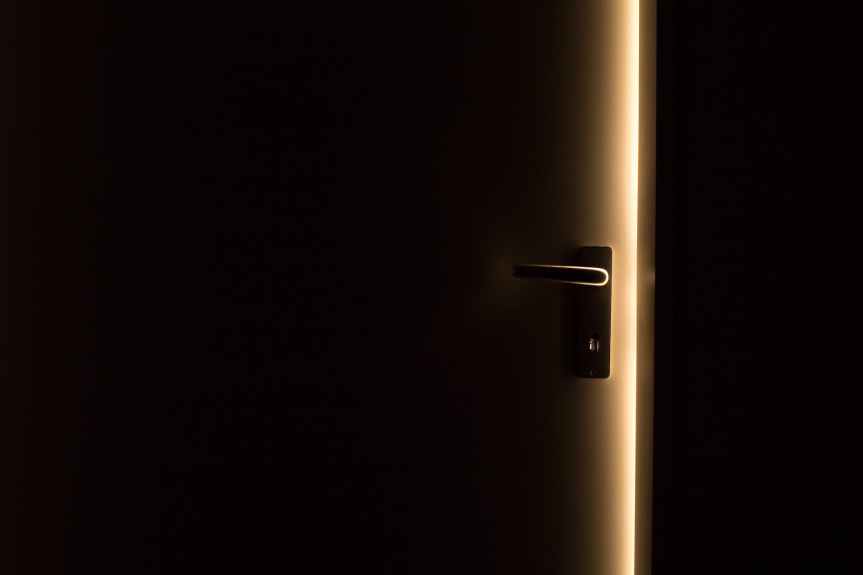
My favorite word, in grad school, was liminal.
It’s a word of transition, of neither-nor: a word that references the inherent potential of the threshold, of being both-and-not-yet. This word embodies a deep sense both of ambiguity and possibility. It evokes the ephemeral.
I have come across many spaces in my life that I would have defined as liminal, and what some would call “thin places.” Some in hindsight seem obvious: the inside of the heart of Newgrange or a specific piece of the western coast where the sky meets the sea meets the stone. Others, less so: the quiet of a local ridge I often walk that at that distinct dawn moment seemed imbued with otherworldly presence, a drive through thick forest in upstate New York.
If people express confusion about what I mean by liminality in such spaces, I often say: “you know, the Narnia feeling.” The sense that the wardrobe isn’t just a wardrobe, but an entrance point to something greater and more meaningful. These places, these spaces, are where God feels to us to be particularly close, where His presence feels transformative, though He is always present and always changing, always redeeming.
To me, those times and spaces are like glimpses beyond the veil.
I suspect God allows these purposefully, for those of us who need them: little nourishments for weary souls. In these times, much like Jacob observing angels up and down the ladder, we realize what it means that God is with us, that He is closer than we could possibly dream. That the cosmos, as Tish Harrison Warren would have it, is teeming with wonders and enchantment we often cannot see.
But liminality is much less romantic in day-to-day life, when I am the one experiencing it.
Standing in Newgrange, staring out at the sea, or stilling in a forest haze, I often feel a sense of possibility and wonder. But standing on the cusp of anything in my own day-to-day life circumstances makes me antsy. I don’t want to be in-between; I want to be either here or there. I don’t want to be waiting, to be forced into living almost-but-not-yet.
Our comfort always seeks a resolution. I want to know how things are going to be. I would like to be clear on what I can expect. In enchanted moments a threshold is a place of potential that invites lingering. It will not stay like this, always. There is something meaningful here. But in the ordinary a threshold is primarily something I want to step over to get to somewhere more secure.
The transition, though, is where the growth is.
I hate that truth. I rebel against writing that sentence. Because what I want to believe and would really prefer to believe is that growth happens when I’m comfortable: when I know what’s coming and where, when I feel good and secure, and when I am settled in all things. But it’s in transition that God reveals to us new parts of ourselves and who we can be for him. It’s on the threshold that God shows us what we are capable of.
“It’s impossible to rattle you,” a friend told me lately with some admiration. “You’re unflappable. You’re so calm.”
I very nearly laughed. I often feel the opposite of calm. Left to my own devices and confronted with something I cannot handle, I go pinwheeling off in every direction, frantic: an explosion of words and explanations and attempts to understand or fix a situation. I’m not calm, I wanted to tell her. I’m a disaster.
But then I stopped and I remembered something.
When I was a child, I used to pray that God would rapture my mom and my dad and I together. A curious prayer, perhaps—but I had at some point determined to myself that God would need to do that for my sake, because I couldn’t imagine ever living without either of my parents. I didn’t want to live in a world without them because I loved them so much.
As I grew older and into adulthood, I no longer prayed that prayer—but I could not linger much on thoughts of what might be, of the conversations people said adults ought to be having with their parents as they grew elderly. The prospect of age and limitation for two people I loved seemed too daunting to comprehend.
And then my mother was diagnosed with cancer, the first time. After her chemo was complete and they found no sign of the cancer in her body, we returned to a slow and uneasy normal. At some point, during that period, I shared with her a lot of work and life drama that had gone on during her sickness.
“You never told me,” she said, aghast. “You never told me any of that.”
I explained to her that knowing she was going through chemo and her cancer struggle had taught me to manage my own problems first before dumping them on her; I hadn’t wanted to add strain when I could solve issues on my own.
I thought she’d chide me. Instead, washing the dishes, she paused thoughtfully. “I think that’s probably something God led you to do. I think He’s teaching you the things you need to be okay on your own.”
I shrugged it off. “It’s not like we have to worry about that now,” I told her, jubilant from the bright diagnosis.
Less than two years later, she was gone. I see now that my mother was correct: I was being prepared. And I see now that what my friend said was true. I am calm now, about many things, because that threshold space of my mother’s illness—when she was suspended between this life and the next—made me resilient in a way I didn’t anticipate. I grew stronger from a time I felt weak. I became more of who God wanted me to be in that terrible waiting.
This too is the story of Scripture. The Israelites, caught in exile. Abraham, caught in waiting for God’s promises. All of us, caught in the knowledge of redemption as we wait for its fruition. Thresholds everywhere. This is where the growth lives.
And what I wonder more than anything is if I teach myself to see these spaces in my life the way I see thresholds in the world: as places rich with possibility, where I can feel dizzyingly close to God, where I can sense in ways that I cannot at other times what is real and good and true.
I hope so.
I believe so.
Because most of us spend our time in that liminal place, waiting.
 Samaritan's Song
I can’t help but feel that there were tears streaming down your face as you wrote this. As I held my dying father I felt the same sense of suspension. I was in a sacred space. There was such a fullness in that rather empty space. Sending you so much love. Pray for me as I mark daddy’s 10 yr anniversary tomorrow. Not a day goes by when I don’t feel all the feelings. xoxo Regina
LikeLike
So many times that happens when I write! Yes – I know how very much you understand. I prayed for you on the day -and am praying for you still. We do reenter grief afresh, even years and years later. God go with you!
LikeLiked by 1 person