
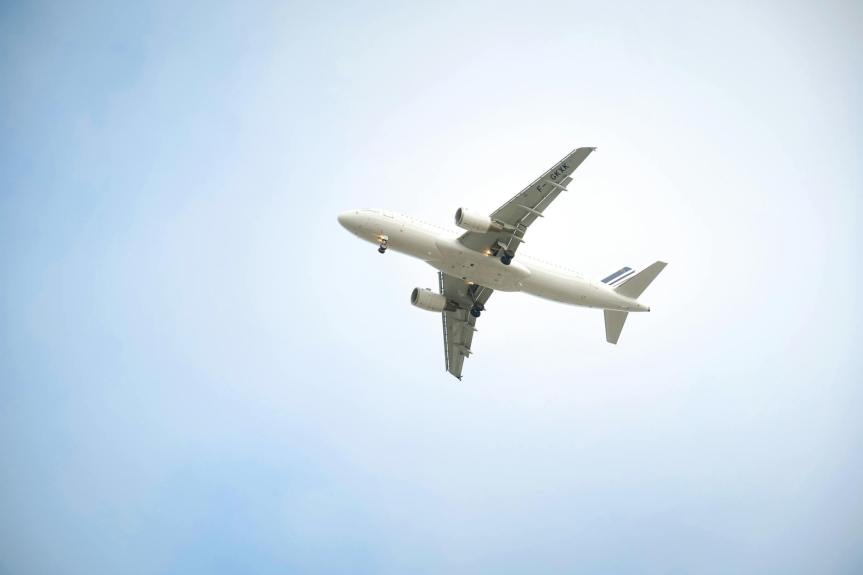
Last weekend, I got back on a plane for the first time in a little over two years.
This followed three different attempts at trips I canceled, overwhelmed by my fear of flying. Bits of phone evidence from the time of those aborted efforts shows my desperation to manage the phobia: snapshotted photographs of Bible verses, reminders of important Scripture, inspiring words and phrases.
How did I manage to overcome it this go round?
Easy. I didn’t.
The year and change I’ve spent in therapy has taught me much about how we can—and can’t—manage our emotions. Sometimes, my therapist tells me, the lizard brain runs wild. At these times, my mind perceives threat in times of perfect calm—assumes, for example, that an upcoming trip is the equivalent of a lion out to eat me. At these times, no amount of logic or discipline can get my brain to shut up, or my body to stop sending fear signals.
It’s easy to dismiss a phobia, of course, until you have one.
Anyone who feels okay about spiders or snakes or enclosed spaces or heights can’t really grasp why the person with them might go white with fear at the sight of an orb-weaver or an enormous boa constrictor or the Sky Tower elevator. But when we encounter our own fears, we have a profound sense that we’re really about to die—that something terrible is going to happen—that this is to be avoided at all costs.
It is hard to describe this, unless you have experienced it. For me, the mere prospect of a plane trip—the sight of the flight app, the mention of my seat number, the sound of a plane in-flight—can send me into a spiral: adrenaline jolts, jitters, skyrocketing breath and heart rate, a sense of deep impending doom.
But what if you accept that feeling? What if you think, okay, and let it be what it is?
The answer, it turns out—at least for me—looks a lot like faith.
I spent two weeks panicking up to the flight. And typically, during times like these, I spent a lot of time engaged with God trying to get him to take the horrible feeling away. I wait desperately for the peace that surpasses understanding. I plead. I cry. I get mad. I grow more and more upset and spiral all over again.
But this time, I asked myself a question: what if I just assume God has allowed me to endure this for a particular reason, and I need to step forward in faith in spite of the feeling?
This did not fix the feeling. Instead, my brain screamed, Okay, but this is awful.
Sure it is, I thought, gritting my teeth. And Stephen being stoned wasn’t pleasant either but—look, whatever we’re enduring God has promised to give us the strength to endure. So despite how it feels I’m going to act as though I am capable of enduring it. Because God tells me I will be—and if I can’t, He won’t allow it.
You know this flight could be a disaster. There’s a storm that might hit.
Okay.
What do you mean “okay”? Storms mean turbulence—you could get scared, get sick, remember that time the plane felt like it was dropping—and you just had an ear infection, remember, so your eardrum is probably going to explode regardless of the weather—and—
And here is the thing. Fundamentally, walking through the phobia meant I had to acknowledge something I think Christians struggle with broadly anyway: God might allow me to be uncomfortable, sad, sick, or hurt.
Doesn’t mean He desires it. Doesn’t mean He inflicts it. Doesn’t mean He’s not good or not God. But at times, we’re appointed to suffer. And our ability to move forward into that suffering, and to accept it, hinges on whether or not we really trust God’s character and what He says is true. Hinges on whether or not I believe He is present with and to me in that, and whether or not He will work good from it, and whether or not He will treat me mercifully in my pain.
Over the past few weeks I fell into the habit of listening to very loud praise music to crowd out some of the anxiety. The effect seemed minimal on the actual physical sensations, but I came to realize there was something both holy and radical in insisting that God was going to be good to me in the face of my rebellious body and brain. Even as they continued to insist everything was wrong, I proclaimed out loud what I know to be true. God reminded me in those moments that gifting does not precede faith but follows it. His hand is out, but it is imperative that I take the first step forward. Even into what terrifies me.
The flight, by the way, was smooth as silk—both going and coming.
But even if it had not been, I knew I would be pleased leaving the plane regardless. I found myself comforted out of nowhere in the airport itself, which is something that has never happened to me before. I did not feel alone. I felt that even though I had to “do it scared,” that “doing it scared” would be enough–would somehow be meaningful and acceptable.
In her recent book Walking with God, Beth Moore writes about her significant back surgery followed by two knee replacements. After a great deal of physical therapy, she is astonished by the movement she’s gained again: the ability to put her heels on the floor, to walk, to go up and down stairs. Yet she catches herself in the grocery store one day slumping over her cart. She chuckles at the realization—she’s forgotten she’s healed. She is carrying the habits of her brokenness even though the brokenness itself is gone.
I don’t know that my flight phobia is gone, per se. I suppose I’ll find out when I fly again in April. But even if it is, I know eventually I am going to encounter a something-else that sets my heart racing and sends me running to God to please take it away. And what I hope more than anything is that when that happens, this stays with me. That I can treat these physical symptoms and my panicked mind simply as a habit of brokenness as I orient myself to moving forward not on what is happening around or within me, but on what I can depend on as certainly true.
This is faith-walking, I think.
It’s hard. It is not always fun. And the treasure is not a release from fear or suffering—simply a chance to meet God and perhaps to please Him there.
Worth it.
 Samaritan's Song