
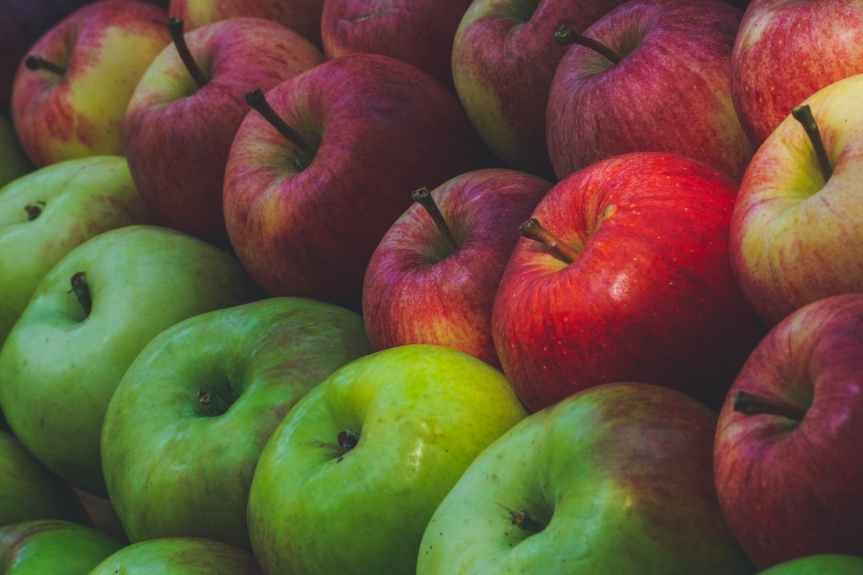
I used to hate apples.
Well, hate is a strong word. I just found them boring. On school lunch trays they just sat there, dusky-red and bland and mealy. I ate four bites and tipped them into the trash.
Growing older, I conceded that green apples were acceptable—meaningfully tart, and they tasted like something—but still liked them best drizzled with caramel syrup and sprinkled with nuts, or dipped into chocolate. I dutifully purchased them pre-sliced, an acknowledgement that I needed to eat a diet that had fruit and vegetables and grains in it.
But after joining a farm co-op two years ago, I’ve become an apple queen. That’s because the apples we receive from the local grower are—well, locally grown, and fresh, and in an abundance of varieties I’ve never tried or eaten before.
We receive apples in every hue and shade: burgundy, wine, ruby, pink. Some of the arrivals, packed into pint bags, are enormous: apples the size of a child’s head. Others are small as my closed fist. The flavors vary, too: from sweet to tart to surprisingly complex. These are not the apples of my childhood. These are apples the way apples are meant to be eaten.
I marvel at this, that God could have made one apple: one singular, phenomenally-good apple, and instead rolled out countless varieties of every hue and flavor. There are heirloom apples available only in certain places in the United States; apples we no longer remember the taste of because they’ve gone extinct; apples that barely resemble what we now know as apples.
I used to hate olives, too.
I still do, sometimes. I rarely find any that I like here in the United States. But in Portugal, at meals, it’s common to receive bread, olives, olive oil, and sheep’s cheese before the main course. Not surprising, for olive groves dot the Portuguese countryside, the trees lining the fields like lines in a notebook—and all hung heavy with green olives.
The olives in Portugal taste like olives nowhere else. And so does the olive oil. Rich, complex, unmistakable. I eat them there dripping with olive oil, flecked with rosemary or garlic, and they are nothing like I have had anywhere. The olive oil I stuffed into my suitcase to bring home carries the fragrant memory of those tastes.
And what I have been thinking about with all these apples and olives is that we lack language.
A language of experience, I mean. The Bible is full of references to olives and cedars and vines, to simplicities of the natural world. I read the reference in Scripture—olives, uh-huh—but until Portugal I didn’t understand what the olive tree really looked like, what it meant and how it produced, what a sort of richness of taste and wealth it was.
I read taste and see that the Lord is good but if all I have in my experience is mealy cafeteria apples then I am really missing out on the rich panoply of what that verse means. In a world where I spend my calories on Fritos and not bread I am missing out on the rich fullness of what bread is and means in Scripture.
The Bible, in this way, guides us to pleasure.
I know we have this Puritan strain of thinking in America that has influenced our Christianity and that often drives us to fear that anything pleasurable borders on hedonism. That tells us it might be better to wear self-flagellate to improve our spiritual character than to spend time enjoying something for the sake of enjoying it.
And it’s true that there are times for discipline. But we need to learn how to be a people of pleasure and great joy, too. And when I say I need to learn that, what I mean is that we need to learn how to experience pleasure in both a godly way and in a way that brings us closer to God. That means no to hedonism and gluttony, certainly, to the sort of indulging that incapacitates or destroys or develops into idolatry, but it also means developing the capacity to enjoy what God provides.
Like lots of different apples. Like olives. Like the touch of a cat’s fur. Like the scent of freshly-tilled fields and damp earth after a rain. Like the snap and crackle of fire. Like cold water on a hot day. Like fresh loaves of bread, or a rich strain of melody, or birdsong.
It has been surprising to me during my year of grief that God has used the language of pleasure to heal my heart. I have developed a singular desire to experience small pleasurable things fully: to savor my latte without looking at my phone, or to listen to a song with my eyes closed, or to stand outside and just breathe in the air after a storm. It is as though to make up for the austerity of mourning, God has supplemented life with many moments of small joy. And these moments of joy have simultaneously informed and enriched my understanding of Scripture, of God.
And anyway, this month is full of them. Autumn is my favorite time for all the sheer sensory delights it offers. And if you find this month difficult or feel tired and overwhelmed and stretched-out, also a familiar sensation to me from this year, then perhaps your answer, too, is to indulge in a small quiet pleasure and allow it to draw you closer to God.
He made all of these things, after all, for us.
 Samaritan's Song
I’m with you — wasn’t much into apples, but changed my tune. I understand apple pectin is also super healing and healthy! 🍏 🍎
LikeLike