
I am about to offer a wild suggestion for your Lent:
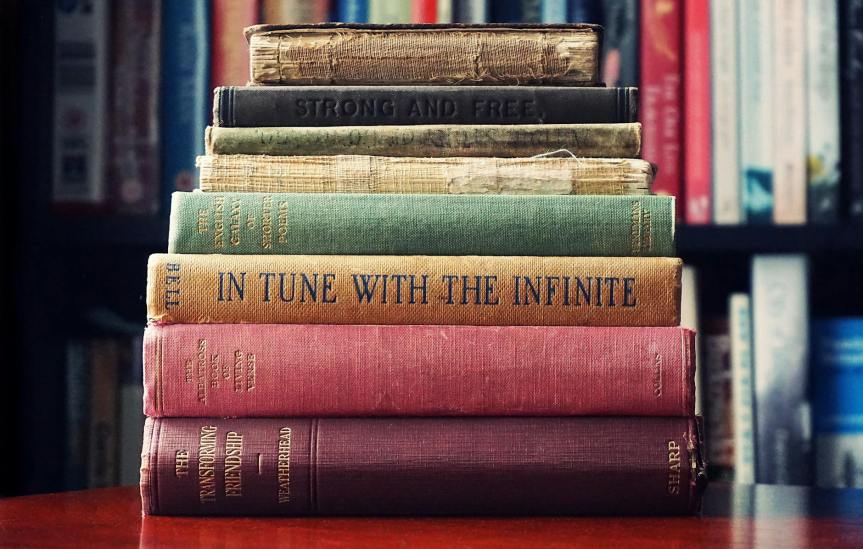
What if you fasted from Christian books, magazines, websites, and other supplementary writings/videos/content outside of Scripture?
Before I explain why this might be a practice worth undertaking, let me issue two critical caveats:
- Christians books, theological texts, treatises, and the like are very important for many reasons. Some foundational texts undergird critical theological doctrines and stances; some inform our behavior and help us make sense of modern life through a Christian lens; still others bring us encourage, renewal, and a fresh way of thinking about Christ.
- Some people, during seasons like Lent, benefit from adding Christian reading (outside the Bible) to their repertoire. If it’s not something you do often, adding a Christian book or article to your day can be a way to help keep God on your mind, or may even help replace a far-less-spiritual habit (scrolling!) that you engage in.
But with those two caveats out of the way, may I make my case?
Christians aren’t exempt from information overload. The Christian publishing industry churns out books and studies at an alarming rate. Magazines, journals, websites,and social media produce content daily: encouraging stories about salvation and conversions, articles on why AI might be beneficial or harmful, how we ought to think about xyz political issues, how our theology ought to manifest on this concern or that. As believers, we have more to read about our faith than we’ve ever had at our fingertips before.
This is both a blessing and a curse.
How do they bless? Well, as I mentioned in my caveat above, they can encourage us, inspire us, help us to think better, convict us, move us, and help us understand more about Scripture and about God. This is fantastic. I wouldn’t be the Christian I am without Beth Moore, Philip Yancey, C.S. Lewis, Richard Beck, Tish Harrison Warren, Esau McCaulley…the list goes on and on.
But. This much content can also be a curse. Let me break down some of my concerns:
- We’re at risk of being disciplined by Christian writings, and Christian authors, rather than by Scripture. I know many wonderful Christians authors. And what I read from them is almost always, in some ways, an explication of Scripture. But an explication of Scripture—even a very good one—is not Scripture itself. We’re already at low levels of Bible literacy, and I suspect this is due at least in part to a sense that reading about what’s in the Bible is the same as reading the Bible. It isn’t. Watching a quick TikTok breakdown of a Bible verse, however inspiring, is not the same as the practice of—regularly, consistently, faithfully—encountering Scripture and sifting it yourself.
- We’re at risk of bubble-building. I don’t know about you, but when I seek out Christian books or magazine articles I’m generally looking for topics that interest me or that I care about or that resonate in some way. Writ large, the world makes it possible for us now to curate what we consume so that we are never challenged, provoked, or convicted; this can happen in Christian circles, too. It’s very hard for us to get outside the realm of our own biases, even when we think we’re doing our best.
- We’re at greater risk of encountering false teachers and not being able to differentiate them. Not all Christian writers or creators are alike. Not all are grounded in Scriptural truth or sound theology or orthodoxy. And while we can sometimes know what is what, often, it’s also impossibly hard to tell. Information literacy is a literal part of my job—I have a Ph.D. in English—and even I struggle at times discerning some of the assumptions, motivations, and at times falsities behind what I am reading. At times I’ll read something that seems just a little skewed—it sometimes takes a significant amount of research to figure out what and why.
- Scripture as a whole should be our standard. This pairs with the previous struggle: we can’t identify false teachings if we don’t know what’s true. And we can’t discern what’s true from a cherry-picked verse or chapter or even a whole book. If we know Scripture as a whole, we can better evaluate the other things we read. And yet more often than not, we spend more time on those things than in God’s word. Perhaps this explains why some proclaimed believers seem eager to hew to the Old Testament’s eye-for-an-eye without taking any consideration for the Gospel itself or for the Sermon on the Mount.
- We have to leave room for mystery. The Enlightenment, and much of Western society, has made us believe that we can read, analyze, and apply everything before our eyes. We certainly benefit from reading and studying about the Christian life, but God used other means for the ancient church and can use the same with us as well. God can reveal Himself in ways that are not always through text or video. God’s revelation of Himself can be deeply personal, at times experiential, and dependent on our ability to saturate ourselves in His word and listen. If we spend all our time letting a multitude of voices speak into our lives, we can sometimes crowd out something God might want to say in other ways. Sometimes, steeping yourself in His word and simply waiting can offer a revelation or conviction that no author or thinker can produce.
- We should be wary of the industries we buy into with our money. Christian publishing – how wonderful! But it is an industry, and the job of any industry is to make money. We ought to be wary of where we put our income, for our money might be used to support much of which we are unaware. The companies that produce books–and articles–and videos–may not be as Christlike as you would hope, or might engage in practices antithetical to what we believe. Even unintentionally, some industries may support or engage practices or behaviors that leave us uneasy. We can choose where we place our cash.
- “Reading about being Christian” can’t replace…being Christian. I can only speak for myself but, sometimes, when I read a book or article or watch a video about God, it makes me feel very holy and in-tune. Holier, perhaps, would be to spend that time in service to someone or following out Christ’s commands in a more lived way. For us bookworms and introverts, especially, it can be easy to trick ourselves into believing that reading and studying about God is the same as serving Him or being His hands and feet in the world.
So maybe throw out the articles and books and TikToks and blogs—not for forever, but for the period of Lent. Scripture only. Saturate yourself in it. Teach yourself the richness of that well, and wait. Test what you discern, if anything, with your church community and local pastors/priests/teachers and with the entirety of Scripture and Christ’s teachings.See what unfolds.
Will it be boring? Probably. The King James does not read like a Beth Moore Bible study.
Will it be challenging? I don’t doubt it, particularly if you wind up in the uncomfortable bits of Scripture you’d prefer to avoid.
Will it be transformative? I don’t see how it can’t be. The Word is living and active; God pierces our hearts. Something about the Word of God works a mystery on us and in us—but it can only do that if we give it the space, and the time, and don’t crowd it out with a thousand other voices we find better or superior or more illuminating.
Take a chance. Try something new. Carve out a spacious new expanse for God in your life, and see what follows. He is faithful; you won’t be disappointed.
 Samaritan's Song
This is an excellent post. Its is “balanced” in that you have important nuance. For example, I have encountered “Bible only” people who quite literally seem to avoid or shun books written about the Bible and theology, and say “the Bible is all we need.” (That would be another topic! But we need the community of faith, the words and input of others. Etc.)
Your 7 points are each so good! I liked this one: “We’re already at low levels of Bible literacy, and I suspect this is due at least in part to a sense that reading about what’s in the Bible is the same as reading the Bible. It isn’t.”
LikeLike
You can correct the typo: “its is”
LikeLike
Thank you so much, Laura! As you know, the nuance is everything. There are extremes in every direction! I’m so glad you enjoyed this one!
LikeLiked by 1 person