
I think frequently of Miss V, who no longer knows me.
She was a congregant at my childhood church: the life and the heart of the congregation. Her laughter was unmistakable in the sanctuary, and she spent much of my life ministering to everyone in the church through illness, deaths, births, and marriages.
Her presence was constant. When my mother was sick, Miss V. arrived at the door with full four-course meals and utensils. When congregants needed healing, she led the prayer vigils in the sanctuary. She drove people to doctor’s appointments, delivered groceries, visited the hospital, taught Sunday School, watched children, oversaw the hospitality ministry, and otherwise basically ran the affairs of the entire church.
Then her son died, in his fifties, from a brain tumor.
Miss V. bounced back, as much as one can after such a tragedy. Yet years later, at the beginning of what was supposed to be a long and glorious retirement, Miss V experienced another unthinkable loss: her husband, himself a devoted and loving congregant of the church, committed suicide. He was—we later learned—in the beginning stages of dementia. But that hardly mattered. Miss V found her world turned upside down.
She still laughed. Still worked for the church. Still gave with extravagant generosity on her meager retirement income. But, as happens in this body of death, age and sorrows set in. She was still able to enjoy living alone in her tiny home, and even got a dog she adored, but health struggles made life harder. She got more nervous driving as her eyesight deteriorated, and eventually had to rely on the kindness of family and friends for errands. Her back caused her no end of trouble, sometimes rendering her immobile for days.
Eventually, a stroke rendered it impossible for her to live alone, and she was moved into the only assisted care home that would accept her limited income. A neighbor had to take the dog. Her house and many of her possessions were sold.
For a time, there, she even managed to minister to those on her floor—she wheeled her chair into residents’ rooms and struck up conversations about God. A steady stream of church members visit her regularly. But time has taken its toll. Now, Miss V. is bed-bound with almost no vision remaining. Much of her memory has gone, and her cognitive functioning is not consistent.
God always grants his mercies, even in these painful times. The last congregant who visited her reported that she had forgotten her husband’s awful death and only remembers the good times; she tells visitors her son is “waiting for her to visit any day now,” and that she is excited to see him, and I believe that is truer than true. She can, I am told, rattle off Scripture with an astonishing ease, which is a reminder to me to embed as much as I can in my heart before my mind fails, if it should.
Even so, I might once have called this a tragedy, or questioned God about it.
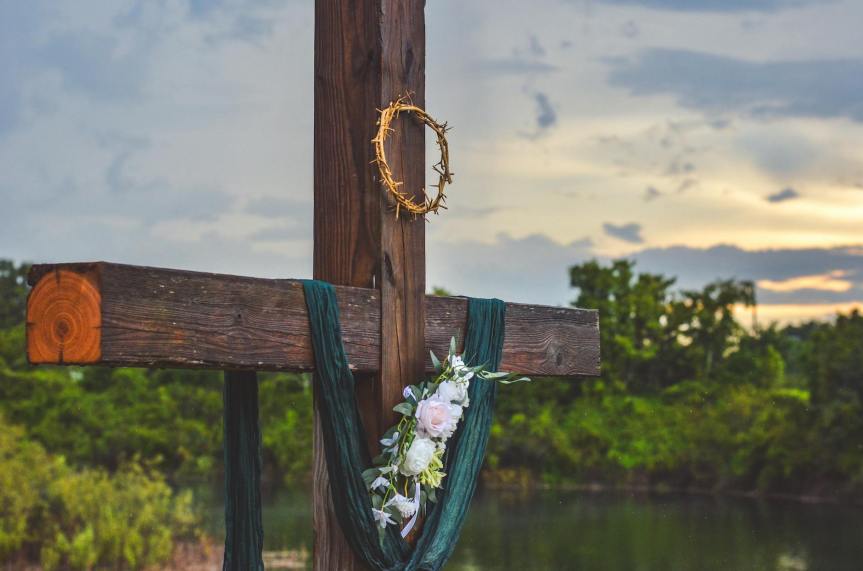
The years have softened me in this regard, I suppose. Miss V’s current state is certainly not what I or anyone wanted for her, and I would change it if I could—but here at Easter, I can recognize in a way my younger self could not that this will not last. This is a form of waiting. This is a suffering, yes, but one that will be redeemed with all things. Indeed, the waiting is only made bearable because of Easter.
Sometimes—isn’t it strange?—triumph looks like this.
I don’t mean that it looks like cognitive failure and being bed-bound. I mean it looks like being able to behold all the misery of this wreck of a world, the grief and the things that shouldn’t have happened, and the things that decay and fall apart, and the bad things that happen to good people, to recognize them fully for how awful they are, and to thank God that this isn’t it.
In The Body of This Death, the last Archbishop of Lancaster writes that we live in a thin reality; that everything we experience now is a pencil sketch compared to what is to come. That the great mistake is to assume this is the real and the full, without understanding that in some ways what we must endure is a prologue to a prologue to a beginning.
Thinking that, and with Easter in mind, I can wonder: what will Miss V’s story be?
Not this one. Not here. The other greater story she’s waiting to enter, that I will share with her and so many others. These daughters of the King: what grace and wisdom will they have on that other shore? What happiness will they experience, to be able to see their sufferings transfigured—not abandoned nor unacknowledged, but made whole? Who will Miss V be, there? Herself, but more herself than she has ever been here even at her best and happiest.
That’s what makes the waiting bearable.
Something strange starts to happen, as you get older. Things like death and heaven and a redeemed heaven and earth at the beginning seem nice in the abstract and maybe a little horrifying up close. In my twenties I was happy my future destination was assured, but I wasn’t much interested in what it would take to get there. In my forties, now, I still don’t know what it will all be like and I can’t say I am particularly eager to go through the Valley of the Shadow of Death, but—
—but, dimly, can’t I see the torches before me of those I know and love? And can’t I see, as Tolkien once put it, a distant shore beyond the curtain of gray?
It’s not as trite as “you get to heaven when you die.” It’s not as trite as “God wants to give you a happy ending,” although I frankly love and embrace happy endings. It’s this: that God Himself decided death and sorrow and grief could not stand, for love’s sake and love’s sake alone. Because of this, a sunrise of glorious possibility exists beyond the pale miseries that this place sometimes offers.
And every year that passes makes me more grateful.
 Samaritan's Song