
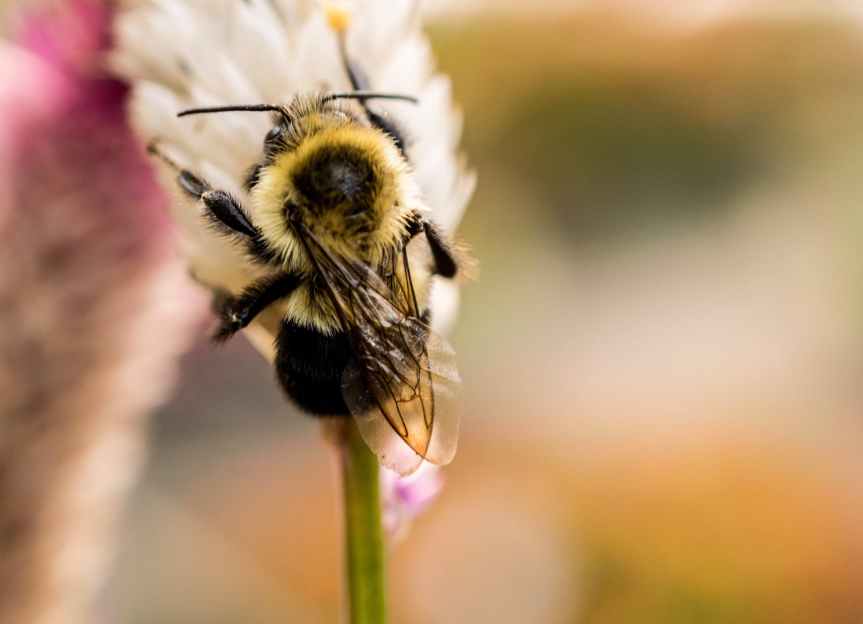
This year, we have bees.
I don’t mean that they intruded on our peace like uninvited guests. We asked for them. When we spoke to our landscaper, our first and primary request was for native plants and flowers that would support the birds and bees and butterflies in the area.
The first year—last year—nothing much came of it. Everything bloomed, but the only flying insects I saw were thousands of mosquitoes, yellowjackets and the periodic wasp. The milkweed grew at a frantic pace and bushed out and attracted a small army of orange aphids; the lavender struggled, pitiful. We compensated by overwatering.
But this year we knew well enough to leave the lavender alone and the hot dry summer has worked its magic: the lavender is huge and enormous, fragrant in the mid-afternoon with its tall purple blooms swaying in the breeze. And the bees. The bees!
I walked out astonished one morning to find at least twenty in one bush alone.
Fat fuzzy bumblebees. Smaller, more delicate honeybees. All day, everyday. They head straight for the lavender—their favorite of all our plants, by far—and float from bloom to bloom. In the afternoon when I stand on the porch the air is filled with a pleasant drowsy buzz. The bees are present when I step out just before dawn for my morning walk; they seem to vanish, by and large, as the sun sets.
I used to be afraid of them.
I was that woman at picnics: the one who, hearing a buzz next to her ear or seeing a bee’s flight in my peripheral vision, would scream and throw my hands up and run away from the table. I have waved dishcloths and napkins at them and scolded them for flying too close to my food. And to be fair, I still don’t like yellowjackets (who as I understand it now, anyway, are not “true bees”).
But I have grown fond of our bees, here. I can stand out on the porch right next to the lavender bush and they fly around and about, undaunted by my presence but also profoundly peaceful. They are not interested in bothering me; they want to be left alone to their flowers. Once, when I was standing close, a bumblebee arrived and landed on my shirt. It explored for a minute, learned I was in that classification of materials known to it as Not Flower, and then flew back off again to the lavender.
I didn’t think about any of this until I ordered a pizza delivery recently and opened the front door to find the delivery guy standing at the very bottom of our driveway, his suspicious gaze on the lavender bushes. “Uh,” he said, helplessly, “that’s a lot of bees—”
I wanted to explain to him that they won’t hurt anything, and least of all him, but realized that would take more time and effort than either of us was prepared for that particular night. I retrieved my pizza and sent him on his way.
The bees teach me a great deal.
They chide me about my boredom, my desire for variety and stimulus. It’s their joy to return to the same lavender bush in the same yard day after day after day. They have located the good stuff; it does not occur to them that they should search for better or more or different. This is good, the bees announce each morning as they crowd the plant. This is the good stuff. Why move?
They force me to be attentive. I walk out my front door in the morning and I see them, and their busy activity draws me into the day and out of my own head: my thoughts, worries, fears, ideas. We leave a tiny “watering hole” for them out among the flowers: a small flower-shaped glass filled with water. One morning I walked out and saw that a honeybee had fallen fully inside the glass and was submerged; he thrashed in the water.
I panicked that the bee was drowning—a thought I could not ever have imagined having—and knelt and gently tipped over the glass. The water spilled out and then the bee emerged, bedraggled but otherwise fine, and it sat gathering itself for a moment before it immediately returned to the lavender. I refilled the glass but put a stone in it to allow adventurous water-drinkers an escape route, should they delve too deep.
Still, the experience cast the mood of my day. I found myself wondering if I am half so compassionate to people as I am to my bees. I spent the day trying to be. It changed my view of many aggravations that followed, delivered me from frustrations to empathy. First care for them, I find myself thinking when confronted with individuals I am inclined to dislike or who seem designed to cause me problems. First care for them and then worry about everything else.
Mostly, though, God has used the bees to remind me that I don’t know what I think I know, and that much can change over a short span. Two years ago, I was a Woman Who Didn’t Like Any Bees and now I am A Woman With A Great Fondness For Bees. I moved from fear to familiarity, and that is a strange and a rare sort of growth. It was experience that moved me from Point A to Point A, the exposure to something different then the norm. And in this small way my experience with the bees mirrors my experience with grief after my mother’s death: before they came, before my mother passed away, I was another person, and now that my mother has passed away and the bees have arrived I am becoming someone new. God uses the moments, large and small, to transform us. I find myself wondering how else I might change, or who I might become, if only I let myself be open to the experiences ahead of me.
Taste and see that the Lord is good. Well, the bees certainly do, through my lavender, and I see the mastery of God at work in their little busy flights and fuzzy fat bodies, and in the heavy summer drone in my yard. Again and again, day after day, and every day a lesson or a thought, reminders about who and how to be couched in the smallest of creatures.
 Samaritan's Song
I love this story of transformation and how God can indeed use the small moments and His creation to teach us His lessons. It has happened to me too, many times.
LikeLike