
There is a C.S. Lewis quote that particularly strikes me of late:
“The value of the myth is that it takes all the things we know and restores to them the rich significance which has been hidden by ‘the veil of familiarity.’ The child enjoys his cold meat (otherwise dull to him) by pretending it is buffalo, just killed with his own bow and arrow. And the child is wise. The real meat comes back to him more savory for having been dipped in a story; you might say that only then is it the real meat. If you are tired of the real landscape, look at it in a mirror. By putting bread, gold, horse, apple, or the very roads into a myth, we do not retreat from reality: we discover it. As long as the story lingers in our mind, the real things are more themselves.”
The veil of familiarity. Dullness. Tired of the real landscape. Has there ever been a better description of the sludge of the everyday?
There exist in Scripture promises and truth: that the kingdom of heaven is here. That love has conquered death. That we are the beloved children of an infinitely good and generous God. That our sufferings here will not be lost or neglected, but redeemed and transformed.
I can also attest that “the veil of familiarity” falls over every single one of these things on any random workday.
I do not feel like the beloved child of an infinitely good and generous God; I feel tired, and hormonally cranky, preoccupied with a to-do list that only ever seems to grow. The kingdom of Heaven feels difficult to locate against a landscape of crabby coworkers, long lines at the grocery store, the guy who sits in front of my house and revs his engine loudly for no reason. My sufferings sometimes seem to eclipse everything and their transformation and redemption feels very distant in the face of the urgent now.
Losing sight of God and the kingdom is the eternal battle for the believer. Given half a second and a traffic jam and everything we think we know flies out the window. More often than not, life feels ordinary at best and like a quagmire at worst. We experience fleeting moments of understanding—we see darkly, as in a mirror—but then the “real landscape” reasserts itself again.
Lewis offers a way out of this. Story and myth, ways of re-seeing the world around us, can shake us out of our familiarity and help us to see things as they really are. Jesus used parables, after all, to illustrate profound concepts to those who followed Him. There are ways for us to reinvigorate our eyes of enchantment, to see as God would have us see—to recognize the sacramental in the everyday, the kingdom playing out before our eyes.
I do this several ways. One is by re-reading The Lord of the Rings.
It is a practice I almost always engage in when I am discouraged. Why? Because in this fantasy story, the characters make mistakes. They encounter profound trials and dangers. They do not, in some cases, come out as fine as before. They make difficult decisions in demanding circumstances that may or may not be correct. And yet a providential hand still works all of those things—what they didn’t know, what they chose, what they didn’t choose—into a purpose they could not have foreseen.
God does this for us, all the time. But what I can’t see of this in the ordinary everyday I can see in that story—and then, having seen it, can return renewed eyes to my own life. Reading The Lord of the Rings (which is, by the way, the eventual subject of Lewis’ quote above) gives me a fresh way of seeing redemption, grace, salvation, and mercy.
But even if you don’t read fantasy, or that particular trilogy, there are ways to engage these fresh eyes.
Music can be one: a transportive medium that can pull you out of the here and now into a place of wonder and renewed understanding. Other books can serve this purpose. So can a beautiful vista or landscape, even in your own backyard. Pets and wild creatures can inspire it. A friend recently sent my dad a video from his trail cam of four baby bear cubs following their mother along the path with a note: “Praise God!”
What I’m saying is: find the thing that refreshes your holy seeing.
There are so many options, so many opportunities. By making a little bit of room for them, intentionally and purposefully, we can cultivate a way of seeing that accompanies us into our everyday (or, at particularly trying times, takes us out of it). The kingdom and the wonderful truths we hold do not always make themselves apparent in ordinary, but we can make a concerted effort to reorient ourselves to reality in a way that helps us to see it differently.
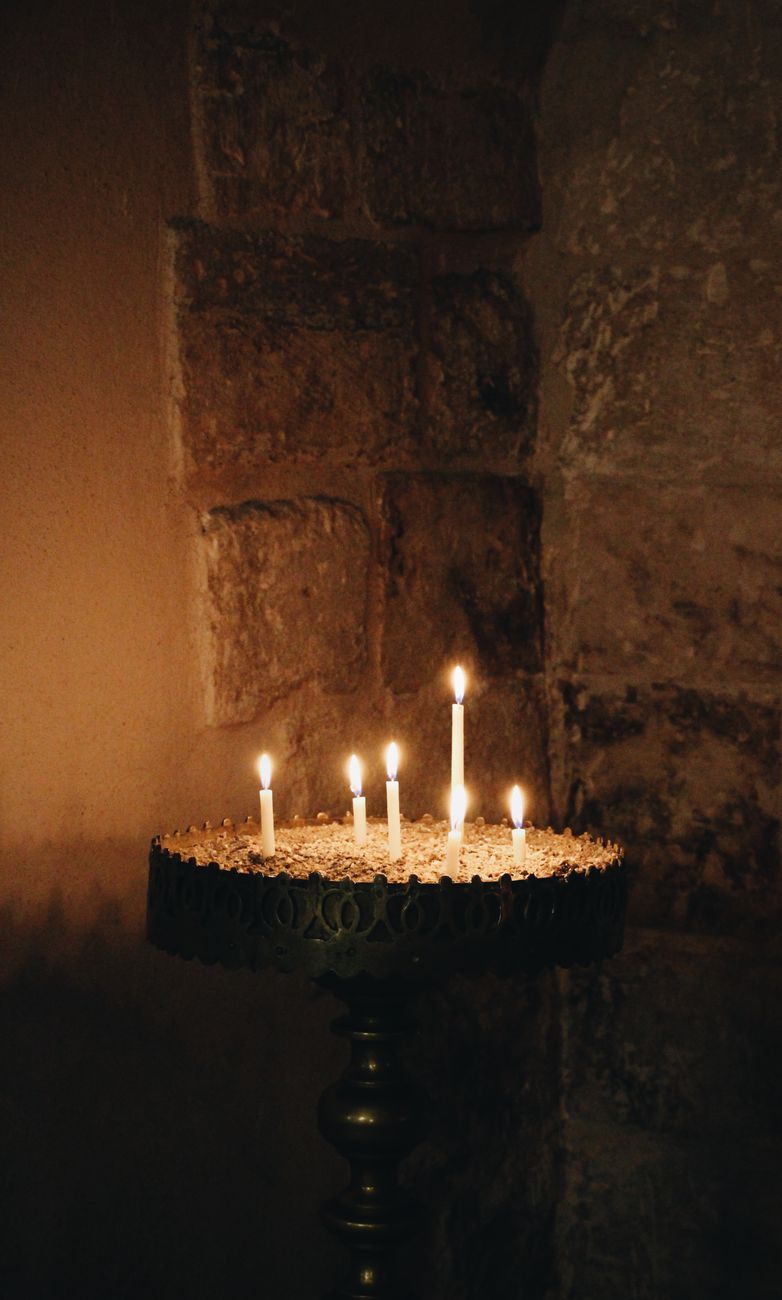
As I write this, I’m thinking of a candle on my desk.
It is made by a small local religious company. It smells, delightfully, like holy incense. I burn it when I pray and at no other time. But sometimes, midday as I walk by my desk, I unscrew the lid and inhale the scent. Something about it is transporting, holy: a hint of fragrance that reasserts the kingdom of Heaven before me.
It doesn’t take much. But oh, how we need it: a reminder of everything that is but that we can’t see, of everything that will be but that we can’t always feel. A spiritual deep breath that allows us to see the very plain parts of our very plain lives truly, with the faith-filled eyes of the soul.
Don’t neglect it.

