
It has taken me a while to admit that Christianity can be a difficult faith.
Even now, I think, some fellow believers might laugh at the idea. “God is love,” they might point out, “and what’s so hard about that?” Or maybe, having been singularly blessed, they might wonder why any faith where God is so good could be hard for anyone.
But Jesus tells us that following Him is hard. He says it several different ways, several different times. This is difficult. This is difficult. You will not find it easy. Few can manage this.
Even growing up and during my life as a Christian, I’ve assumed that faith being “difficult” had something to do with self-denial or self-discipline or even with suffering. It’s hard, after all, to be good when you want to be bad. It’s hard to go through painful things.
And all of this is true to a degree. But fundamentally, I feel like I can embrace the complexity of my faith because these past few years have oriented me to what God has been saying in plain sight for ages and in every way possible:
You don’t get to love anything more than you love Me.
For those who aren’t believers, the very sentence might look offensive. But among Christians, I imagine some people may not understand why that’s hard. God is infinite love, infinite compassion, infinite mercy! God is Jesus. God willingly sacrificed Himself for us! How can you not love God?
Well, certainly the God who asks us to love anything is all those things. He’s also incomprehensible, beyond our understanding, mysterious, all-knowing, the essence of holiness and truth. He is Jesus, yes. And also the Holy Spirit. And also the Father. In Christ we see God revealed in human flesh. But there is much of God we can’t understand, the part of us that Paul says sees in a mirror, darkly. That doesn’t understand now, but will understand fully one day. Some day.
It’s not just you don’t get to love anything more than you love me. It’s also:
Love me more than anything when you can’t see my face.
Love me more than anything when you don’t understand what I’m doing.
Love me more than anything when I say ‘no’ for no reason that makes sense to you.
Love me more than anything when I make you wait.
Love me more than anything when I permit what you must endure.
Love me more than anything when I must take something away.
Love me more than anything when it hurts and you don’t know why.
And that can be hard. Maybe the hardest thing.
It’s easy in theory, of course. Why do we love God in all those circumstances? Because we know Him and He’s revealed Himself to us. Because we understand who He is. Because we believe in His promises and even if we don’t understand the fine details we know how it will all shake out. Because we know He will redeem all things. Because He provides comforts, gifts, immeasurable blessings even in the darkest dark.
But in practice it can be both hard and painful.
We are people of immediacy. People who long for comfort and cozening. People who want explanations and sometimes feel we deserve them. People who feel loss keenly. People who mourn. People who dream big. People who wish for more. People who ache to be loved. People who find it hard to think beyond the present moment. And for all these reasons it is easier, so much easier, to turn to what fulfills those needs. To love what fulfills those needs—in the way that we want, in the time of our choosing.
I think often about the night my mother died.
The night my mother died we hit a deer, of all things. Well. We didn’t hit it ourselves. The truck a span in front of us did, swerving off the road post-collision and leaving the carcass behind. We had no option but to brace for impact as we processed what had happened—wince as we heard the scrape of something hard against the undercarriage—and pull over once it was safe to assess the damage.
I don’t know what I envisioned would happen on the drive home to my father after the saddest call of my life, but it wasn’t my husband and I shivering on the edge of the road in the predawn dark, looking under the car with flashlights in an amateur assessment of whether we could continue the five-hour drive.
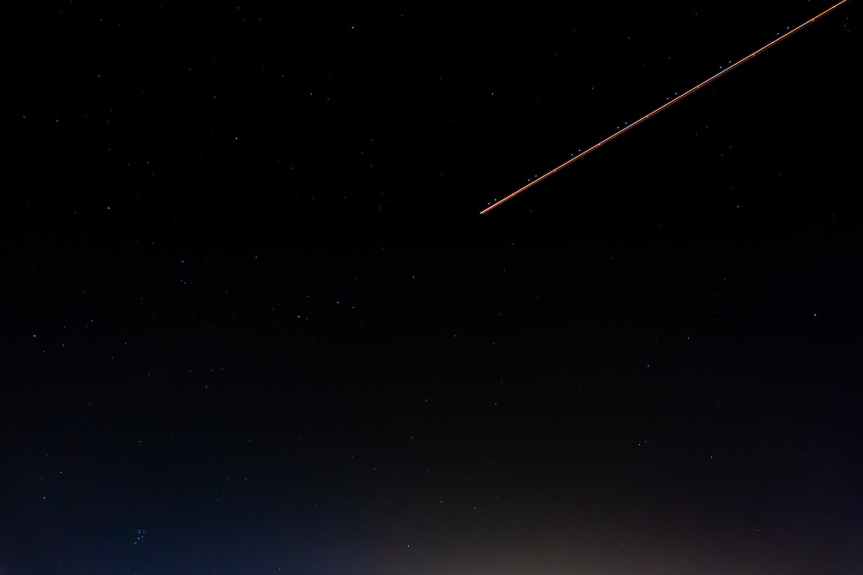
On the night my mother died, I also saw my first falling star.
The sky was dark and clear, the stars extra-visible out in the middle of the country where we were driving, and I was sitting holding a McDonald’s coffee I couldn’t make myself drink, staring out the windshield, trying to sort things out in my mind. And then a star fell: a beautiful glimmering trail, there and gone. If my husband hadn’t seen it too, I would have assumed I imagined it.
And I think a lot about God and the world He’s made and His presence in my life, and I think about that deer and that falling star. The deer was a raw moment that was pure death and sadness on a miserable night that already held death and sadness. But that star was a sliver of pure grace that could not have been more appropriate to the moment: as though God wanted to acknowledge that something beautiful had passed from the world, but chose to leaven the hurt with astonishing beauty.
This is how it goes.
Dead deer, falling stars. We live in a world with both. We are asked to endure both. And God persistently asks us, in that world, in all of those circumstances, if He can be our first and greatest love.
This is what can make faith so difficult, can also be what makes it grow. Because God does not prioritize the things we prioritize. He prioritizes His relationship with us. But that doesn’t always mean prioritizing our comfort, our fulfillment, the smoothing-away of inconveniences and tragedies and hurts.
And so, in all circumstances, we are called to the question: Do you love me? Do you love me?
The answer, as I have found it, is in acceptance. Yes, I do love you, and so I’ll accept whatever is from you right now and assume you will give me whatever tools needed to sort it out. Yes, I accept the deer in the road as much as I wish it hadn’t happened. I accept losing my mother, too, as much as I wish it hadn’t happened. I accept this and that and the other, because I love you, because I trust you.
But there is one more important thing.
God never asks for our love without expressing His first. We are never asked to answer the question before hearing His assertion: I love you. And it is His I love you that colors whatever else we’re asked to endure. It is because He loves us that the path we are asked to walk in faith becomes possible. Otherwise, do you love me? becomes a question that chokes any possible response.
Yesterday was the one-year anniversary of my mother’s death. Something I found strange after her passing was how, in the immediate aftermath, I couldn’t seem to shake images of her suffering and her sickness. Whenever I dreamed of her, I dreamed of her ill. And yet here, a year later, as I find myself thinking back to that awful night, I think not just of her, not just of that deer, but of the falling star too.
I love you, God was saying. Will you love me more than anything else?
Even now, yes.
And even in whatever comes, I pray I will.
But I couldn’t do if it I hadn’t been loved first.
 Samaritan's Song
Beautifully written. Thank you.
LikeLike
🙏🏻✝️
LikeLike