

Here are two quick truths about me:
I am known to be an excellent public speaker.
I get incredibly nervous about public speaking. Sometimes.
The nervousness usually comes when the stakes are high: when I’m speaking about something deeply significant to me, when I’m intent on a certain outcome, when I’m engaged for a work event. The jitters set in days in advance: the morning of, I shoot out of bed like I’ve been spring-loaded and generally have to contend with nonstop adrenaline until the speaking engagement is over.
When I was telling this to my mentor recently, he taught me a psychological trick called “anchoring.” It works a little like this: you close you eyes, calm yourself down, and you vividly imagine a memory of a time when you felt cool and calm and collected during your public speaking. As you’re imagining that, you “anchor” yourself to the memory with a tiny gesture: rubbing your wrist, tapping your fingers together, whatever.
You do this over, and over, and over again. Soon enough, before previously-stressful speaking events, you can begin doing this and attain that cool, calm, competent state of mind. To see something like this in action, watch Lebron James’ chalk-throwing before a game. It’s a way of stepping into a certain space, a certain part of yourself.
I found it very helpful, and told my mentor so. He grinned. “Well, the brain is easy to trick.”
And ain’t that the truth.
Our brains are wonderful, complex organs, still in some ways a mystery scientists continue to try to solve. This is both good and bad. Good for all the obvious reasons, and bad because sometimes we can deceive ourselves with our own minds. We see or hear things that aren’t there; develop memories we never experienced; engage in every sort of bias and manipulation at times to our own detriment.
And it is this that, as a Christian, I find helpful to remember: that I can be easily deceived, even by myself, that I can invent what I perceive as realities, that I can act and react on the basis of my thoughts alone which may or may not be trustworthy. That sometimes, we can be our own greatest enemy.
There’s a frequent meme I see on the internet. You’ll probably recognize it too:
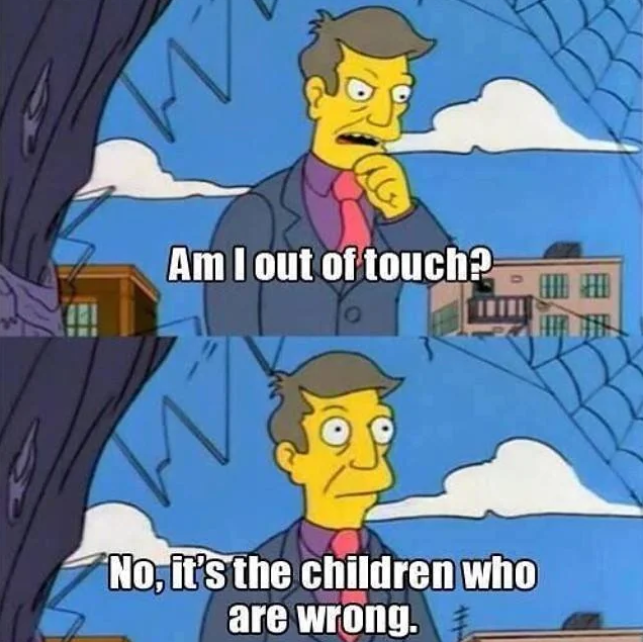
The meme is a reminder of how easily we can choose to rely on “our own truth,” on the sum of our own cogitation and experience. Better and easier to believe that others are wrong than to believe that we could be. Better to doubt ourselves last.
For me, this is the great struggle of faith: the choice between God’s reality and mine, between God’s truth and whatever it is my mind invents. My mind and my thoughts can tell me that a situation is desperate, that there’s no hope, that nothing good can come of the circumstances; God tells me otherwise. The world can tell me to panic, hide, despair, but God tells me otherwise.
We always calibrate ourselves to something. Now more than ever modern culture tells us that our bodies and our minds hold the truth of all things. To be fair, our minds and our bodies can tell us a lot. They can also deceive us. My body tells me I want six servings of Cheetos; my mind sometimes tells me I am alone. I know better than to listen to either.
To have faith, I think, is sometimes as simple as this: to determine what the truth is, and to behave according to that truth regardless of whatever else is going on to the contrary. To some, that reads as delusion. To some, faith is delusion. But that is the crux of the thing: am I going to act as if what I think or feel is true, or as if what God says is true?
The choice is often harder than it seems.
We struggle, not least because everything going on around us feels so real. Much of our culture lives in the grip of fear, anxiety, panic, terror, loneliness, a thousand small agonies. And for me, this is also why church is critical. This is a space we can enter into where we remember God’s truth and see it lived out, where we get to bathe in it for a while before we wander back out into the world again.
I’ve mentioned before here that I sometimes struggle with anxiety. The perverse gift of this issue is that it keeps me cognizant of the recklessness of my own mind. When I feel anxious, as much as I might want to get rid of the feeling, I recognize that my mind is ginning up much of my experience. There is no tiger in my bedroom who plans on eating me; what I’m feeling is what my mind has spun out as an understanding of experience. And so with faith: I can stop, at times when I am feeling a particular way or things look particularly bleak, and I can remind myself that my mind can be deceived
Stay on guard, always.
Stay vigilant, always.
What seems to be doesn’t necessarily mirror what is.
 Samaritan's Song